


In today’s interconnected world, the gadgets in our pockets, the cars we drive, and the software we use daily are rarely the product of a single nation. They are the result of a complex, invisible web of deals known as Free Trade Agreements (FTAs).
While they often sound like bureaucratic paperwork, FTAs are actually the “operating system” of the global economy. Here is how they work, why they matter, and how they are evolving in 2026.
1. What Exactly is a Free Trade Agreement?
At its core, an FTA is a pact between two or more nations to reduce barriers to imports and exports. In a world without these deals, countries often protect local businesses by hitting foreign goods with taxes (tariffs) or limiting quantities (quotas).
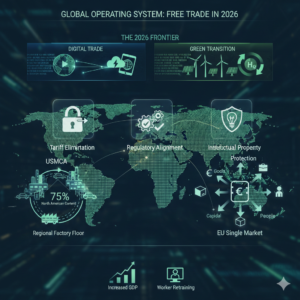
An FTA works by addressing three specific friction points:
- Tariff Elimination: Removing the “entry fee” for goods crossing the border.
- Regulatory Alignment: Ensuring safety and technical standards are consistent so a product doesn’t have to be redesigned for every country.
- Intellectual Property (IP) Protection: Guaranteeing that patents and copyrights are respected, which is vital for the tech and pharmaceutical industries.
2. How FTAs Supercharge the Economy
Free trade isn’t just about moving boxes; it’s about creating a more efficient and competitive economic environment.
Lower Prices and Better Variety
When tariffs vanish, the cost of imported goods drops. This increases the “real income” of households—when you pay less for a laptop or groceries, you have more money to save or spend elsewhere in the economy.
The Power of Specialization
FTAs allow countries to focus on what they do best—a concept called Comparative Advantage. If Country A excels at high-tech engineering and Country B is an agricultural powerhouse, an FTA allows both to specialize, preventing the economic waste of trying to “do it all” inefficiently.
A Magnet for Investment
Investors love stability. An FTA provides a “Legal Anchor,” guaranteeing that trade rules won’t change overnight. This often leads to a surge in Foreign Direct Investment (FDI), as companies feel safe building factories and offices in signatory nations.
3. Real-World Powerhouses: USMCA and the EU
To see these theories in action, we can look at two different models of integration:
- The USMCA (North America): This agreement focuses on regional manufacturing. For example, it requires that 75% of a car’s components be made in North America to qualify for zero tariffs. This has turned the region into a massive, integrated “factory floor,” with Mexico recently becoming the top trading partner of the U.S.
- The EU Single Market (Europe): This goes beyond a standard FTA. It allows for the “Four Freedoms”: the free movement of goods, services, capital, and people. A nurse from Poland can work in Ireland, and a French company can sell to Germany without a single customs check. Research shows this integration has added over 2% to the EU’s total GDP.
4. The 2026 Frontier: Digital and Green Trade
As we move through 2026, FTAs are evolving to meet the challenges of the digital age and the climate crisis.
- Digital Trade: Modern deals (like the recent India-EU FTA signed in January 2026) now include “Digital Chapters.” These ban customs duties on digital transmissions (like streaming or software downloads) and protect the source code of AI companies.
- The Green Transition: Trade is becoming a tool for the planet. New agreements are slashing tariffs on “green goods” like solar panels and wind turbines. For instance, the India-EU deal established a Green Hydrogen Task Force to help decarbonize heavy industry while ensuring that new carbon taxes (like the EU’s CBAM) don’t cripple developing economies.
5. The Balanced View: Managing the Transition
While the net effect of FTAs is overwhelmingly positive for national wealth, the transition can be difficult. Competitive imports can hurt legacy local industries. The most successful nations use the wealth generated by trade to fund worker retraining programs, ensuring that the “losers” of trade today become the “innovators” of tomorrow.
Conclusion
Free Trade Agreements are more than just legal documents; they are commitments to a shared future. By reducing the cost of distance and the friction of bureaucracy, they enable the cooperation required to solve global problems—from lowering the cost of living to accelerating the shift to clean energy.