


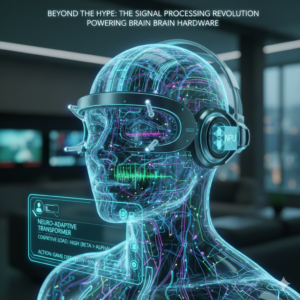
We’ve all seen the headlines from CES 2026: headsets that “prime” your brain and earbuds that track your focus. But for those of us in the tech space, the real story isn’t the plastic casing or the brand name. The real story is how we are finally solving the “Signal-to-Noise” nightmare of the human skull.
Moving BCI from a sterilized lab to a consumer living room required three massive technological leaps in signal processing and AI. Let’s dive into the stack.
1. Dry-Electrode Material Science
Traditionally, EEG (Electroencephalography) required “wet” sensors—conductive gels that acted as a bridge between your scalp and the electrode. Fine for a hospital, impossible for a gaming headset.
The breakthrough in 2025/2026 has been Sintered Silver-Silver Chloride (Ag/AgCl) dry sensors.
- The Tech: These sensors use a high-porosity structure that maintains a stable electrical impedance even through hair.
- The Innovation: Modern hardware now uses “spring-loaded pin” arrays that maintain constant micro-pressure, ensuring the “Ohmic contact” stays consistent even if the wearer is moving or sweating.
2. Neural Decoding & The “Sliding Window” Transformer
The brain is loud. It produces micro-volts of electrical “chatter” that must be distinguished from muscle movements (like blinking or jaw-clenching), which are orders of magnitude stronger.
To solve this, 2026 hardware utilizes Neuro-Adaptive Transformers.
- How it works: Instead of simple frequency filters, the software uses a sliding-window attention mechanism (similar to the architecture behind LLMs) to look at temporal patterns in brainwaves.
- Spatial Filtering: Techniques like Common Spatial Patterns (CSP) and Canonical Correlation Analysis (CCA) allow the device to “triangulate” exactly where a signal is coming from within the cortex, effectively “tuning out” the rest of the brain’s noise.
3. Closed-Loop “Neuroadaptive” Algorithms
This is where the tech moves from passive to active. A standard heart rate monitor just reports data; a 2026 BCI device uses a Closed-Loop Feedback System.
- Inference: The device decodes that your “Cognitive Load” is exceeding a specific threshold (Beta wave spikes vs. Alpha wave drops).
- Action: The system triggers an API call to the software—slowing down the difficulty of a game, or silencing notifications on your OS.
- Reinforcement: The AI observes the brain’s reaction to that change. If the stress levels drop, the model “weights” that intervention as successful, personalizing the neural map to that specific user over time.
4. The Edge Computing Challenge
Processing raw EEG data is computationally expensive. Sending raw brainwaves to the cloud would create latency that makes real-time control impossible.
- The Hardware Stack: Most viral BCI tech now includes a dedicated NPU (Neural Processing Unit) on the device itself.
- The Result: Feature extraction and artifact removal happen at the “Edge,” with only the high-level intent (e.g., “User is Focused”) being transmitted via Bluetooth or Wi-Fi.
The Road Ahead: “The Silicon-Carbon Interface”
We are moving away from “interpreting” data to “interfacing” with it. As machine learning models become more efficient, the barrier between a digital command and a biological thought is thinning.
The tech community is no longer asking if we can read the brain—we’re asking how we can optimize the bitrate of that connection.