


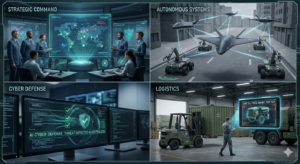
The face of conflict has undergone a profound transformation. In 2026, military superiority is no longer measured solely by the size of an arsenal but by the speed and accuracy of the data driving it. We have entered the era of “Hyperwar,” where artificial intelligence acts as the central nervous system for global defence, moving at speeds that far exceed human reaction time. This shift is not just an upgrade to existing tools; it is a fundamental rewriting of how security is maintained.
1. From Human Decision to Autonomous Action
The most significant change is the rise of Agentic AI—systems that don’t just follow a set of “if-then” rules but can autonomously plan and adapt to a changing environment. This is most visible in the deployment of autonomous drone swarms. Hundreds of small, inexpensive units now use edge computing to coordinate with one another in real time, overwhelming traditional defences with sheer numbers and synchronised movement. Unlike older models, these swarms can navigate through GPS-jammed zones using “machine vision” to recognise terrain. By synthesising satellite imagery, intercepted signals, and sensor data in seconds, AI helps commanders identify and respond to threats before a human operator could even process the first alert.
2. The Invisible Battlefield and the Ethical “Loop”
Beyond physical drones, AI is the primary weapon on the “invisible front”. Modern conflict is increasingly a digital siege, where automated cyber defence systems use machine learning to predict and neutralise attacks on critical infrastructure—like energy grids and communication networks—before they even begin. However, as machines become more capable of identifying targets, the global community is locked in a debate over the “Human in the Loop”. This principle insists that while technology provides the speed, the moral and legal responsibility for taking a life must remain a human burden. The goal for 2026 is to ensure that AI acts as a high-tech shield and advisor, providing “meaningful human control” even as the tempo of battle accelerates.
The Path Forward
As we look ahead, the challenge isn’t just building faster algorithms but building responsible ones. AI is transforming the battlefield into a place of unprecedented precision, but its success will ultimately depend on how well we balance machine speed with human judgement. The most effective defence forces will be those that treat AI not as a replacement for the soldier, but as a partner in maintaining a more stable and predictable world