


When we think about the environmental footprint of artificial intelligence, we usually picture massive, windowless data centres humming in the desert, gulping megawatts of electricity. But there is a quieter, more urgent environmental crisis brewing behind every prompt you type: water.
AI has a massive, hidden thirst. Yet, in a twist of tech irony, the very tool straining our water reserves might be our best shot at saving them. Tech pioneers are starting to realise that the ultimate goal shouldn’t just be reducing damage—it needs to be “water-positive”, meaning our use of AI must ultimately return more clean water to the planet than it consumes.
Here is a look at the dual nature of AI’s relationship with water and the technological blueprint to replenish the earth.
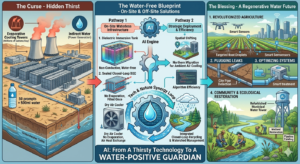
The Curse: The Hidden Thirst of the Cloud
AI doesn’t just run on code; it runs on water. Data centres generate immense amounts of heat. To keep thousands of servers from melting down, traditional facilities rely on evaporative cooling towers that lose millions of gallons of water daily to the atmosphere.
Furthermore, there is an “indirect water footprint”—the staggering amount of water used by power plants to generate the electricity that data centres consume.
- The Cost of a Prompt: Research indicates that training a large language model like GPT-3 in a state-of-the-art data centre can directly evaporate roughly 700,000 litres of water. On an individual level, a simple conversational exchange (about 10 to 50 prompts) can “drink” a 500ml bottle of water.
- The Global Scale: As tech networks expand globally, local water tables are feeling the squeeze. By 2030, AI’s global water consumption is projected to match the annual drinking water needs of the entire United States, straining municipal supplies in drought-prone regions.
The Blessing: How AI Can Help Save Our Water
While AI is a heavy consumer, its predictive power and optimisation capabilities make it an unprecedented weapon for water conservation. We cannot manage what we cannot measure, and that is where AI excels.
1. Revolutionising Agriculture (Smart Irrigation)
Agriculture accounts for roughly 70% of global freshwater withdrawals, often wasted through inefficient flooding. AI-driven precision agriculture changes this entirely. By processing satellite imagery, IoT soil-moisture sensors, and localised weather forecasts, AI algorithms calculate the exact millilitre of water a crop needs, down to the individual plant—slashing agricultural water waste by up to 40%.
2. Plugging the “Invisible” Leaks
Global water infrastructure loses an estimated 100 trillion litres of treated, drinkable water annually to underground pipe bursts before it ever reaches a tap. AI platforms utilise acoustic sensors and pressure data to detect microscopic anomalies in pipelines, predicting and locating leaks so cities can repair them long before they turn into catastrophic main breaks.
3. Restoring Watersheds and Predicting Floods
AI models can simulate complex urban water networks to optimise recycling processes and maximise wastewater treatment efficiency. Beyond the city grid, AI is deployed to monitor river health, track pollution plumes, and analyse weather patterns to predict severe floods, allowing communities to safely harvest rainwater and protect local ecosystems.
The Blueprint: Shifting to Zero-Water Tech & Water-Positive Systems
We cannot afford to abandon AI, but we cannot afford to run out of water either. To turn the tide, the tech ecosystem is completely reimagining infrastructure—either by replacing water entirely with alternative cooling technologies or by actively giving back to local communities.
Breaking the Water Dependence: Zero-Consumption Cooling
The holy grail of sustainable tech design is removing freshwater from the day-to-day operations of data centres entirely. Engineers are now deploying cutting-edge alternatives:
- Liquid Immersion Cooling (Dielectric Fluids): Instead of water, entire server racks are submerged in massive tanks of specialised, non-conductive synthetic or bio-based oils. The fluid traps the heat, cycles through a sealed loop, and returns to the tank. It never evaporates, meaning zero water is consumed.
- Sealed “Closed-Loop” Direct-to-Chip Cooling: Operating like a car’s radiator, micro-tubes deliver liquid coolant directly to a metal plate on top of the processing chip. Because the system is entirely airtight, the fluid is used indefinitely without ever boiling off or needing a municipal top-off.
- Dry Air-Cooling & Northern Migration: In arid regions, data centres are opting for advanced air-cooled chillers that reject heat using high-efficiency fans rather than water evaporation. Better yet, tech giants are moving heavy AI workloads to sub-arctic climates (like Iceland or Finland) to pull freezing outside air directly through server halls for “free cooling”.
Actively Replenishing the Planet
Where liquid infrastructure is still required, tech infrastructure must adopt a circular, community-first framework:
- Circular Reuse: Shifting away from pristine groundwater, modern data centres are utilising treated municipal wastewater or industrial greywater, recirculating it through closed systems to protect local drinking supplies.
- Algorithmic Efficiency: Software engineers are rewriting code to make AI models lighter. Efficient algorithms require less processing power, less heat generation, and fundamentally less cooling energy.
- Community Replenishment: To achieve true “water-positive” status, tech companies are funding local ecological projects—restoring natural wetlands, updating broken municipal pipelines, and donating smart-irrigation tech to nearby farmers to return billions of gallons back into strained watersheds.
The Bottom Line
AI has borrowed heavily from our planet’s most precious resource to build the future. However, by replacing evaporative cooling with zero-water technologies and directing AI’s computational brilliance inward—to fix our infrastructure and optimise our farms—we can close the loop. We can transform a thirsty technology into a water-positive guardian of the world’s most vital lifecycle.