


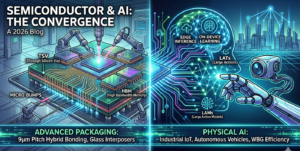
The boundary between the digital and physical worlds is no longer just blurring—it is dissolving. As we navigate the second quarter of 2026, two forces have emerged as the twin engines of global sovereignty: semiconductors and artificial intelligence. For India, this isn’t just an industrial shift; it is a strategic metamorphosis. We are moving from a nation that “uses” technology to one that “architects” it.
1. The Production Milestone: From Intent to Execution
For years, the global conversation around India and chips was one of “potential”. In 2026, that narrative has shifted to “production”. With the commercial operationalisation of major plants in Gujarat and the recent groundbreaking of the nation’s first advanced 3D semiconductor packaging unit in Odisha, India has secured its place in the global supply chain. This is a critical victory. In the semiconductor world, advanced packaging is the “new Moore’s Law”. By mastering these high-value segments, India is insulating its digital economy from the volatility of global disruptions.
2. The “Paper-to-Prototype” Mandate
At the heart of our mission at MIT-WPU is the transition from lab to market. The semiconductor industry is the ultimate proving ground for this philosophy.
-
Design Sovereignty: Under the India Semiconductor Mission (ISM) 2.0, we are seeing a surge in fabless startups. It is no longer enough to assemble chips; we must own the intellectual property (IP).
-
Full-Stack Innovation: By incentivising domestic hardware and critical mineral processing, India is building a “full-stack” ecosystem. We are teaching our students that a research paper is only the beginning—the goal is a functional prototype that powers a national high-tech manufacturing success.
3. AI as a National Utility: Bharat-VISTAAR
While the world focuses on general LLMs, India is pioneering social AI. The launch of initiatives like Bharat-VISTAAR—integrating agricultural data for real-time farmer advisory—demonstrates how AI can be a tool for radical inclusivity. With over 38,000 GPUs now deployed under the IndiaAI Mission, our researchers and startups have the “compute-oxygen” they need to innovate. We are treating AI not as a luxury but as a utility—as essential as electricity or water for the 21st-century citizen.
4. Nurturing the Gen Z Entrepreneurial Mindset
Our greatest asset remains our human capital. But in 2026, a degree in electronics is not enough. We are fostering a “Gen Z Entrepreneurial Mindset” through initiatives like the Smart India Hackathon and RIDE Conclave. We are training a workforce of over 60,000 VLSI engineers who don’t just understand circuits but understand the business of silicon. This synergy between academic rigour and industrial demand is what will sustain India’s momentum.
The Road Ahead
India’s emergence as a top-five global semiconductor hub by 2030 is no longer a distant dream—it is a mathematical certainty if we stay the course. As we bridge the gap between our classrooms and the global fab units, we aren’t just building chips; we are building the future of a self-reliant, technologically sovereign Bharat.
The era of silicon and intelligence is here. And this time, India is leading the symphony.