


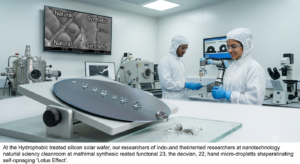
Nature mastered nanotechnology millions of years before humans built our first cleanroom.
If you’ve ever watched water droplets roll off a lotus leaf, you’re looking at a solution to one of green technology’s biggest operational headaches: soiling and efficiency loss.
In dusty and harsh environments, solar panels can lose up to 30% of their energy yield simply due to dirt, dust, and grime accumulation. Traditional cleaning requires millions of gallons of water and costly maintenance.
Enter Biomimicry.
By studying the microscopic, wax-coated nanostructures on the surface of lotus leaves, researchers in materials science and nanotechnology are developing self-cleaning coatings that change the game:
- Superhydrophobic Surfaces: Water droplets can’t flatten or adhere; instead, they bead up perfectly and roll off at the slightest angle.
- The “Self-Cleaning” Action: As the droplets roll, they trap dust particles and carry them away, keeping the surface clear without manual scrubbing or harsh chemicals.
- Broader Applications: Beyond solar panels, this bio-inspired technology is now being applied to outdoor IoT camera lenses, optical sensors, and micro-grid monitoring equipment—ensuring uninterrupted data collection in extreme conditions.
When academic research looks to natural phenomena to solve engineering challenges, we move closer to truly zero-maintenance, self-sustaining technologies.