


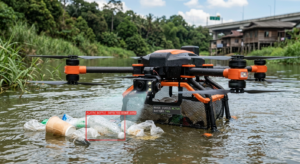
Oceans account for over 70% of the Earth’s surface, but over 80% of ocean plastic originates from land-based river systems. Intercepting waste before it reaches deep ocean currents requires a shift from manual dredging to autonomous, continuous waterway management.
Computer Vision and Edge-AI Waste Classification
Traditional barriers collect debris indiscriminately of type, but autonomous aquatic drones process visual data in real time.
- Onboard Trash Recognition: Object detection models classify floating waste—distinguishing organic wood and leaves from polyethylene bottles, microplastic rafts, and industrial foam.
- Targeted Interception: Edge-AI navigation dynamically steers the vessel toward high-density waste clusters, maximizing battery efficiency during operational sweeps.
Autonomous Swarm Robotics for River Deltas
Cleaning sprawling estuaries and unpredictable river currents exceeds the capacity of single-unit systems.
- Decentralised Swarm Logic: Fleet units communicate via low-power mesh networks to coordinate spatial coverage, preventing overlaps and sharing real-time waste location heatmaps.
- Self-Docking & Unloading: Drones autonomously return to solar-powered shore stations to empty collected debris bins and swap batteries without human intervention.
Paper-to-Prototype: Engineering Aquatic Resiliency
Deploying environmental hardware into turbulent aquatic environments presents unique challenges—corrosion, water ingress, and variable currents. Moving technology from “paper to prototype” means designing hydrodynamic hulls, integrating solar-supplemented propulsion, and stress-testing autonomous obstacle avoidance in real-world river channels.
By combining computer vision with autonomous marine robotics, we are creating continuous, scalable defence systems for local water ecosystems.