


When floods, landslides, or remote geography cut off ground transport, the first few hours—the “Golden Hour”—determine critical outcomes. Traditional logistics often stall during crises, but autonomous drone technology is closing the gap, turning critical field challenges into rapid-response aerial lifelines.
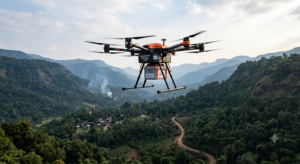
Autonomous Beyond Visual Line of Sight (BVLOS) Navigation
In emergency scenarios, cellular networks often fail or offer spotty coverage.
- Mesh Network Relays: Modern relief drones utilize decentralized ad-hoc communications, allowing fleet units to act as flying signal relays.
- Edge-AI Obstacle Avoidance: Onboard computer vision and LiDAR sensors process spatial data locally, enabling safe navigation around fallen trees, power lines, and changing terrain without relying on GPS or manual piloting.
Temperature-Controlled Precision Payload Delivery
Transporting blood, anti-venom, vaccines, or organ transplant supplies requires strict thermal regulation and zero vibration impact.
- Smart Cold-Chain Pods: Payload compartments feature real-time IoT temperature sensors that automatically adjust active cooling based on ambient conditions.
- Winched Precision Drops: Instead of landing on unstable or flooded ground, drones hover precisely and lower emergency kits using autonomous winches, ensuring zero ground risk for bystanders.
Thermal Vision for Rapid Search-and-Rescue (SAR)
Finding survivors in dense forest canopies or debris fields after a natural calamity demands high-speed aerial coverage.
- Infrared Anomaly Detection: AI algorithms scan multi-spectral camera feeds to instantly flag human thermal signatures in vast terrain.
- Predictive Mapping: Machine learning models cross-reference topography and survivor reports to automatically route drones toward high-probability rescue zones.
Paper-to-Prototype: Building Resilient Aerial Systems
Transforming aerial robotics research into field-ready disaster response requires rigorous stress testing. Moving technology from “paper to prototype” means engineering carbon-fiber airframes that endure high winds, developing swappable battery systems, and ensuring seamless integration with local emergency response commands.
By deploying robust autonomous systems, we are turning emergency logistics into an instant, reliable infrastructure when time matters most.